
A dental bridge is a fixed restoration used to replace a missing tooth or several teeth in a row. Unlike a removable partial denture, a bridge stays securely in place and is designed to restore the appearance of your smile and comfortable chewing.
How a Dental Bridge Fills the Space of a Missing Tooth
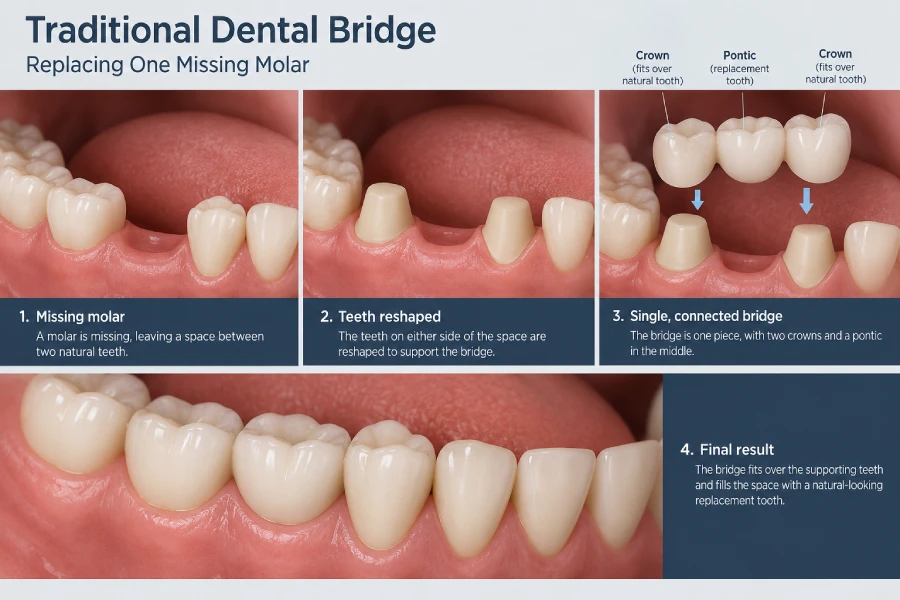
A traditional dental bridge uses the natural teeth on either side of an open space to support the replacement tooth. For example, if you are missing one molar, the teeth on either side of the space are reshaped to support a single, connected bridge. The bridge fits over both supporting teeth, with a replacement tooth, called a pontic, filling the space between them.
Once the bridge is permanently bonded into place, the replacement tooth sits above the gum where the natural tooth used to be. It looks and functions like a tooth but does not have its own root.
Implant-Supported Dental Bridge
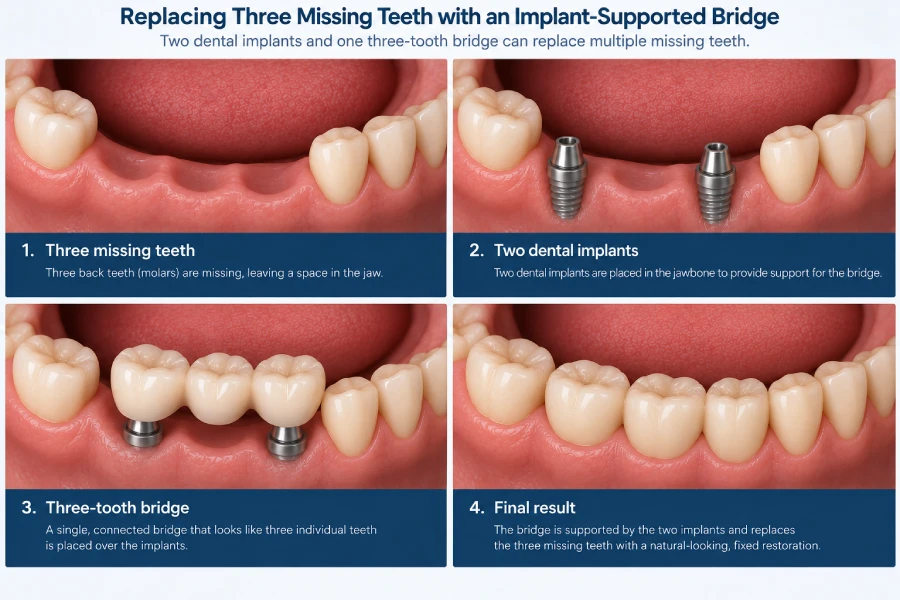
An implant-supported bridge replaces several missing teeth in a row without relying on the neighboring natural teeth for support. Instead, dental implants are placed in the jaw to anchor the bridge securely in place.
For example, three missing teeth in a row may be replaced with two dental implants and one three-tooth bridge. The bridge is a single connected restoration that looks like three individual teeth, with the two implants underneath providing support.
Because the implants are anchored in the jawbone, they also provide stimulation to the bone when you bite and chew. This helps preserve the bone around the implants and is an important difference between an implant-supported bridge and a traditional bridge, which replaces the visible teeth but does not replace the missing tooth roots.
Traditional Bridge vs. Implant-Supported Bridge
There are several differences to consider when comparing these two approaches.
| Traditional Bridge | Implant-Supported Bridge | |
| Fixed in place | ✅ | ✅ |
| Replaces missing teeth | ✅ | ✅ |
| Supported by natural teeth | ✅ | |
| Supported by dental implants | ✅ | |
| Requires neighboring teeth to be reshaped | ✅ | |
| Leaves healthy neighboring teeth untouched | ✅ | |
| Provides stimulation to the jawbone | ✅ | |
| Requires implant surgery | ✅ | |
| Requires a healing period before the final bridge | ✅ |
The right option depends on your oral health, treatment needs, budget, and personal preferences. We can help you compare both approaches and determine which is the better fit for you.
Replacing a Single Missing Tooth With a Dental Implant
A dental bridge is not the only option for replacing a single missing tooth. A dental implant can support an individual crown without relying on the neighboring teeth.
Unlike a traditional bridge, the implant is placed in the jawbone where the tooth root used to be. Once the implant has healed, a custom crown is attached to complete the replacement tooth.
Visit Clearwater Dentistry in Greeley, CO
At Clearwater Dentistry, we provide custom dental bridges for patients who want a fixed, natural-looking way to replace missing teeth. If you have missing teeth, Dr. Alan Baughman can evaluate the space and surrounding teeth and help you compare traditional and implant-supported options based on your individual needs.
Visit us at 3110 67th Avenue Place, Greeley, CO.
FAQs About Dental Bridges
Yes. Porcelain dental bridges are designed to match the color, shape, and size of the surrounding teeth. The goal is for the replacement teeth to blend naturally with your smile.
No. A fixed dental bridge is permanently attached to natural teeth or dental implants. You do not remove it for eating, sleeping, or cleaning.
Yes, food and plaque can collect underneath the replacement tooth because it sits above the gum rather than growing from it like a natural tooth. Cleaning underneath the bridge every day helps keep the surrounding gums and supporting teeth healthy.
A traditional dental bridge typically costs between $4,000 and $10,000, depending on the number of teeth involved, the type of bridge, and the complexity of treatment. Implant-supported bridges may have additional costs for implant placement. We can provide a personalized estimate after evaluating your teeth and discussing your treatment options.
Many dental insurance plans provide some coverage for bridges used to replace missing teeth, but benefits vary by plan. Your deductible, annual maximum, waiting periods, and percentage of coverage can all affect your out-of-pocket cost.
Dr. Alan Baughman provides traditional and implant-supported dental bridges as well as same-day CEREC dental bridges at Clearwater Dentistry in Greeley, CO. We can evaluate your missing teeth and help you determine which fixed tooth replacement approach is appropriate for you.
